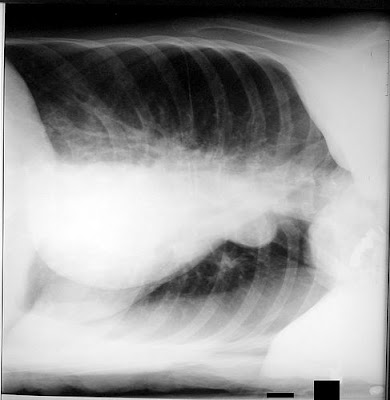
Wednesday, April 15, 2009

Wednesday April 15, 2009
Diagnostic Criteria for Portopulmonary Hypertension (POPH)

Specific diagnostic criteria for POPH obtained by right heart catheterization have been espoused by the European Respiratory Society Task Force on Pulmonary-Hepatic Vascular Disorders
  1. Presence of portal hypertension (clinical diagnosis)A) With or without cirrhosis
  2. Mean pulmonary artery pressure (mPAP) > 25 mm Hg
  3. Pulmonary vascular resistance (PVR) > 240 dynes sec/cm-5
  4. Transpulmonary gradient* > 12 mm Hg

*Transpulmonary gradient = mean pulmonary artery pressure - pulmonary artery occlusion pressure (mPAP - PAOP).


Related:
Power point presentation on POPH (George T. Kondos, MD)


Reference: click to get abstract

Rodriguez-Roisin R, Krowka MJ, Herve P, Fallon MB. Pulmonary-hepatic vascular disorders: a task force report. Eur Respir J. 2004;24:861-880.

Tuesday, April 14, 2009

Tuesday April 14, 2009
Prone positioning in hypoxemic respiratory failure:
Meta-analysis of randomized controlled trials


We have seen the ups and down of prone ventilation. Kopterides did the meta-analysis to assess the effect of prone positioning on intensive care unit (ICU) and hospital mortality, days on mechanical ventilation, length of stay, incidence of ventilator-associated pneumonia (VAP) and pneumothorax, and associated complications.

Result:
  • The pooled odds ratio (OR) for the ICU mortality in the intention-to-treat analysis was 0.97 (95% confidence interval [CI], 0.77-1.22), for the comparison between prone and supine ventilated patients
  • The pooled OR for the ICU mortality in the more severely ill patients favored prone positioning (OR, 0.34; 95% CI, 0.18-0.66)
  • The duration of mechanical ventilation and the incidence of pneumothorax were not different between the 2 groups
  • The incidence of VAP was lower but not statistically significant in patients treated with prone positioning (OR, 0.81; 95% CI, 0.61-1.10)

(However)

  • Prone positioning was associated with a higher risk of pressure sores (OR, 1.49; 95% CI, 1.17-1.89) and
  • Prone positioning was associated with a trend for more complications related to the endotracheal tube (OR, 1.30; 95% CI, 0.94-1.80)

Conclusion: This meta-analysis revealed that prone positioning does not change the overall mortality, but may have benefit in the selected group of severely ill patients. It decreases the incidence of VAP, but has more pressure sores and endotracheal tube related complications.


Reference: click to get abstract

Kopterides P, Siempos I, Armaganidis A. Prone positioning in hypoxemic respiratory failure: Meta-analysis of randomized controlled trials. J of Critical Care 2009; 24(1): 89-100

Monday, April 13, 2009

Monday April 13, 2009
Meld Score: What is it?


It is a model for End-Stage Liver Disease, initially designed and validated for predicting survival in patients with portal hypertension undergoing TIPS (transjugular intrahepatic portosystemic shunt).

Three things used in calculating the predicting models are

1. INR (international normalized ratio)
2. Serum creatinine
3. Serum Bilirubin

It is calculated as

MELD=9.57 x loge (creatinine) + 3.78 loge (total bilirubin) + 11.2 Loge (INR) =6.43

It has played an important role in predicting the mortality in liver disease, and has significantly decreased the liver transplantation time. Patient with Meld score of less than 16 has good survival, and score of more than 24 has poor survival. It also removes favoritism and subjective bias out of transplant preference.


Reference: click to get abstract

Kamath PS, Kim WR.
The model for end stage liver disease (MELD). Hepatology 2007; 45(3): 797-805

Sunday, April 12, 2009

Sunday April 12, 2009

Scenario: 67 yeear old male is now stable after his acute MI and cardiogenic shock. Patient is now 'delined' and 'detubed' and stable to transfer to floor. Whie reviewing morning CXR, you had following picture. Whats your diagnosis ?


Answer: Swan ganz catheter fragment which has broken loose and ended up in the right pulmonary artery.

Interventional Radiologist can remove the lost catheter via procedure call Snare Technique. This is done percutaneously, through a skin incision in the groin under local anesthesia. But Cardio-thoracic surgery should be taken on consult as backup, in case it requires open heart method.


Reference: click to get abstract

Embolization of the Tip of a Central Venous Catheter into the Pulmonary Artery - NEJM - Volume 352:e3 January 27, 2005 Number 4

Saturday, April 11, 2009

Saturday April 11, 2009
Regarding pleural effusions

Scenario:
67 yeear old male presented to ER with shortness of breath. There is significant opacification of left lateral lobe. Your dignosis is pleural effusion with underlying atelactasis. To acertain reasonable amount of fluid to tap (thoracentesis), what could be your next step?


Answer: Perform lateral decubitus films

CXRs done in the lateral decubitus position are more sensitive, and can pick up as little as 50 ml of fluid. Upright chest films need at least 300 ml of fluid to pick up pleural effusion consistent with blunting of costophrenic angles. If the fluid layer is more than 1 cm, there is enough of it to do a pleural tap. Lateral decubitus film may also help in revealing loculated pleural effusions, if any - which may require CT-guided thoracocentesis. 500 ml of pleural effusion is enough to show detectable clinical signs.


Friday, April 10, 2009

Friday April 10, 2009 (pediatric pearl)
Risk factors of upper gastrointestinal bleeding in mechanically ventilated children


Overt upper gastrointestinal bleeding* is common of critically ill children requiring mechanical ventilation (52%).

Significant upper gastrointestinal bleeding*1 is uncommon (3.6%) (Similar to that seen in adults studies).

60% of patients with UGI bleeding occurred on the first day and more than 90% occurred within the first 3 days.

*Overt upper gastrointestinal bleeding = evidence of hematemesis, gross blood, or “coffee ground” material in nasogastric aspirates, hematochezia, or melena

*1 Significant UGI bleeding = defined as a spontaneous decrease of more than 20 mm Hg in the systolic blood pressure, an increase of more than 20 beats per minute in the heart rate, a decrease in the hemoglobin level of more than 2 g/dL, the receipt of packed red blood cell transfusion and gastric or duodenal surgery.


Reference: click to get abstract

Incidence and risk factors of upper gastrointestinal bleeding in mechanically ventilated children - Pediatric Critical Care Medicine. 10(1):91-95, January 2009

Thursday, April 9, 2009

Thursday April 9, 2009

Lumbar Puncture Video
(4:43 mins)


Wednesday, April 8, 2009

Wednesday April 8, 2009
Resistance to Heparin Therapy

Q; What is the most common reason of Resistance to Heparin Therapy (failure of monitoring tests to change or higher than expected doses) ?


Answer:
The most important cause of apparent resistance to heparin therapy is antithrombin III deficiency. Replacement of antithrombin III in a deficient patient may restore heparin efficacy.

Also, its important to know that following commonly use medicines may cause resistance to heparin therapy.

  • intravenous nitroglycerin
  • digitalis,
  • nicotine (smoking),
  • tetracycline
  • some antihistamines

Reference:

Bick RL., Disorders of Thrombosis & Hemostasis. Clinical and Laboratory Practice. 1992. ASCP Press. (Figure 1-29 page 20; Table 14-7, page 305).

Tuesday, April 7, 2009

Tuesday April 7, 2009


Q; 32 year old male - recently immigrated from Africa - presented with hypotension and left flank pain and "Milky Urine". What are treatment options beside resuscitation?


Answer: Chyluria (Milky Urine) is common in many parts of the world, where Wuchereria bancrofti, the main agent of filariasis, is endemic. It occurs, on average, 5–10 years after the worm has died, and so there may be no evidence of active filariasis.

Treatment includes therapeutic trial of diethylcarbamazine should be considered before undertaking surgery for lymphatic urinary fistula.


Reference:

1. Filarial chyluria: Long-term experience of a university hospital in India - International Journal of Urology, Volume 11 Issue 4, Pages 193 - 198, Published Online: 16 Mar 2004

Monday, April 6, 2009

Monday April 6, 2009

Q; What amount of air is usually needed to cause clinical symptoms in Venous Air Emboilsm (VAE)?


Answer:
Around 50 ml

Most occurrences of VAE go unreported because they are asymptomatic due to very small amount of air entering system, but entrapment of large quantities of intravascular gas may lead to severe neurologic injury, cardiovascular collapse, or even death. The factors that determine the subsequent morbidity and mortality include the rate of air entrainment, the volume of air introduced, and the position of the patient at the time of the embolism. Although very small volumes of air can lead to severe sequelae, generally it is accepted that atleast 50 mL of air is required to cause clinical symptoms.

But again, all precautions should be taken to avoid even any small amount of air to get introduce into vascular system as there are case reports in literature showing lethal effect with as little as 20 mL of air (the length of an unprimed IV infusion set) or even 0.5 mL of air in the left anterior descending coronary artery causing ventricular fibrillation.

Related previous pearl: Venous Air Embolism - VAE - immediate maneuvers

Reference:

Venous Air Embolism - emedicine.com

Sunday, April 5, 2009

Sunday April 5, 2009

Q; You inserted a central venous line in a patient with hypoxemic respiratory failure. Procedure went uneventful. Post-procedure CXR is below. What's your concern?


Answer: Arterial Cannulation

Notice - the catheter is taking a sharp left turn just distal to the clavicle.

The best approach in such situation is to obtain radial ABG and ABG from central line to compare. Also to hook central line to monitor to see waveform which may clearly show arterial waveforms.

Saturday, April 4, 2009

Saturday April 4, 2009

Thoracic ultrasound for pneumothorax


Friday, April 3, 2009

Friday April 3, 2009 (pediatric pearl)

Q: Does sustained meropenem use have effect on the pattern of Gram-negative bacillus colonization in patients admitted to a tertiary care PICU?


Answer: No

In a prospective study, after a 6-mo baseline period, all children with serious infections admitted to the PICU during the subsequent 2 yrs were administered meropenem

.
During the period of preferred meropenem use, the amount of meropenem used increased me than orseven-fold, whereas the use of other advanced generation beta-lactams was reduced by nearly 80%.

Conclusion:

1. There was no statistically detectable effect on the prevalence of colonization by Gram-negative organisms resistant to one or more classes of broad-spectrum parenteral antibiotics

2. or to colonization by organisms resistant specifically to meropenem, when meropenem was the preferred antibiotic in a PICU.

3. The incidence of nosocomial infections did not change, and the prevalence of nosocomial infections caused by meropenem-resistant organisms was always less than 1% of all admissions during the period of meropenem preference.


Reference: click to get abstract

Meropenem use and colonization by antibiotic-resistant Gram-negative bacilli in a pediatric intensive care unit - Pediatric Critical Care Medicine:Volume 10(1)January 2009pp 49-54

Thursday, April 2, 2009

Thursday April 2, 2009


The FAST exam
(5:35 minutes)

Wednesday, April 1, 2009

Wednesday April 1, 2009
LOW DOSE VITAMIN K: DOES IT DECREASES RISK OF BLEEDING

Recent article published in Annals of Internal Medicine by Crowther helps to sort this practice. Low-dose oral vitamin K decreases the international normalized ratio (INR) but its effects on bleeding events are uncertain.

OBJECTIVE: To see whether low-dose oral vitamin K reduces bleeding events over 90 days in patients with warfarin-associated coagulopathy.

DESIGN: Multicenter, randomized, placebo-controlled trial with 14 anticoagulant therapy clinics in Canada, the United States, and Italy.

Method: Nonbleeding patients with INR values of 4.5 to 10.0 either received oral vitamin K, 1.25 mg (355 patients randomly assigned; 347 analyzed), or matching placebo (369 patients randomly assigned; 365 analyzed). Bleeding events (primary outcome), thromboembolism, and death (secondary outcomes) were measured.

Results: 56 patients (15.8%) in the vitamin K group and 60 patients (16.3%) in the placebo group had at least 1 bleeding complication. Major bleeding events occurred in 9 patients (2.5%) in the vitamin K group and 4 patients (1.1%) in the placebo group (absolute difference, 1.5 percentage points [CI, -0.8 to 3.7 percentage points]). Thromboembolism occurred in 4 patients (1.1%) in the vitamin K group and 3 patients (0.8%) in the placebo group (absolute difference, 0.3 percentage point [CI, -1.4 to 2.0 percentage points]). The day after treatment, the INR had decreased by a mean of 1.4 in the placebo group and 2.8 in the vitamin K group.

Limitation: Patients who were actively bleeding were not included, and warfarin dosing after enrollment was not mandated or followed.

CONCLUSION: Low-dose oral vitamin K did not reduce bleeding in warfarin recipients with INRs of 4.5 to 10.0.


Reference: click to get abstract

Crowther MA, Ageno W, Garcia D, Wang L et al. Oral vitamin K versus placebo to correct excessive anticoagulation in patients receiving warfarin: a randomized trial. Ann Intern Med. 2009; 150(5):293-300